


10 MIN READ
How the Solea Laser Took the Stress Out of the Procedures I Used to Dread
By Jackson Hall, DDS on November 05, 2026
Key takeaways
- The "cheat code": The Solea® All-Tissue Laser lets me handle stressful hard tissue, soft tissue, and osseous procedures without changing tips or cycling through multiple settings.
- Where it earns its keep: Almost every procedure has a place where Solea makes it smoother, more efficient, or easier on the patient afterward. A few examples: removing broken root tips without losing more bone, often without laying a flap at all; cosmetic cases; and soft tissue and bone overgrowth around implants, where it is a game changer.
- Anesthesia-free fillings are a great bonus, but far from the reason I bought Solea: About 80 to 90% of my fillings are done without anesthesia. We often place topical when we're working near the gum tissue, mostly for the patient's peace of mind.
- The learning curve is mostly a mindset shift: Slow down, think about how the laser could improve the procedure you were about to do, and ask what you would want done if you were the patient.
A few months after I started using my Solea laser, my Convergent Dental Representative, Chad Gibson, asked me how it was going. I told him, "Dude, this thing is great. It's like the cheat code for dentistry."
What is the "cheat code for dentistry"?
The cheat code for dentistry is how I describe the Solea® All-Tissue Laser: a single tool that makes the hardest parts of my day predictable and far less stressful. Solea is the only 9.3-micron CO₂ dental laser, and it is cleared for hard tissue, soft tissue, and osseous procedures.
Here's my analogy: You can beat any video game the traditional way. But when the game involves another human being lying in the chair, who may be anxious, may not want to be there, or may have had bad experiences before, I'd rather put in the cheat code, fly through it, and improve both my day and theirs.
I'm an analytical guy. Before I bought, the Solea users I talked to were enthusiastic, but they struggled to give me specific examples or reasons that made sense to me, especially from a return-on-investment standpoint. So here is the version I wish someone had given me.
Why was I skeptical of dental lasers?
I was skeptical because the lasers I used early in my career made procedures more complicated, not less. As an associate in a large practice, I kept trying to make other hard and soft tissue lasers part of my routine. Every procedure meant stopping to change multiple settings and swap tips. My view is simple: if you add eight steps and tell me that, if everything goes exactly to plan, I might get a 2% better outcome, while the appointment runs significantly longer and every added step is another chance for something to go wrong, it isn't worth it. Eventually I put those lasers down because they were just too much of a headache.
Then I opened my own practice and kept adding to my tool belt: more cosmetics, full-mouth rehabilitation, and more complicated cases. Any dentist who has moved into that part of the field knows that more complicated dentistry comes with more complicated problems. It's not that any one step is extremely difficult. It's that there are so many steps, and any one of them going wrong raises the overall chance of failure.
As I pushed further into those cases, I started looking for ways to simplify procedures without losing quality, especially the parts that are traditionally tedious, like soft tissue work in cosmetic cases. I was also developing a love-hate relationship with implants. I loved what implants could do once they were finished, but most of my patients hated the surgical steps, even something as simple as an uncovering or contouring the soft tissue for the emergence profile. Soft tissue management kept pointing me back to lasers.
So I did a deep dive. I researched every wavelength and laser I could find on the market and ended up reading papers on the physics of laser-tissue interaction, because the reviews were so contradictory of each other. Half the people said their laser was the greatest thing ever and could do anything short of making your car fly. The other half said it caused more problems than it solved and ended up sitting in the corner as a coat hanger.
Then I decided I needed to put my hands on each option, and that turned out to be harder than I expected. At one laser meeting, I could watch demonstrations run by a company representative under very specific settings, but when I asked to try the laser myself, the answer was no. That was frustrating. The companies told me their lasers could do incredible things if I just followed their protocols, but most of the dentists I talked to who actually owned one had been so frustrated that they had given up, which matched my own experience.
I had already met Chad, my Convergent Dental Rep. After going through every other company, I called him and asked if he would let me test-drive a Solea. He said, "No problem. I'll see you next week." He showed up the next week with the laser, extracted teeth, an apple, and some chicken. I asked if I could just have at it, and he said, "Sure." I turned up the power and started carving designs into the apple, cutting teeth in half, and cutting the chicken into neat little pieces. By the end of that session, I was in.
What convinced me the Solea laser was different?
It started with that test drive. Chad let me put my hands on it and try anything, knowing I hadn't signed anything and that if it didn't live up to what he told me it could do, I wasn't going to buy one. I left convinced of what I would be able to do with it, and that only scratched the surface. I purchased that week.
Then two cases in my first weeks with the laser sealed it.
The first was a patient with a loose implant crown. A dentist in my area had been filling the screw access channels of implant restorations completely with composite, with no barrier between the composite and the screw. I had already handled one of these cases the traditional way, and it took me an hour of improvising, because removing the composite from the screw access destroyed the screw, and I could not simply remove it with a driver. When a second patient from the same practice showed up with the same problem, I cringed and told my team I would be tied up for at least an hour getting the composite and the screw out, hopefully without destroying anything.
I sat looking at the access hole, trying to plan my approach and already frustrated. Then I glanced over and saw the laser in the corner. My assistant wheeled it over, and I turned it on. Within 15 to 20 seconds, I had removed all of the composite without harming the screw or the implant in the slightest. I unscrewed the crown, checked for problems, tightened it back down, and torqued it to specification. The appointment was done in a matter of minutes.
The second came a day or two later: an extraction. Anyone who takes out maxillary premolars knows the feeling: you feel the click, and you know a root tip just broke off. Now you're looking at 5 to 10 more minutes of digging while the patient wonders what is happening, maybe trimming tissue or raising a flap, all while irritated that a little root tip broke off. This time, before I reached for a handpiece, root tip elevators, or a scalpel, I had my team bring over the Solea and plug it in. I aimed right at the root tip and let it rip.
Within one to two minutes, I had completely ablated the root tip, used the laser to clean out the remaining soft tissue in the socket, placed my bone graft, and moved on. What would have been a 5- to 10-minute headache, with a lot more discomfort for the patient afterward, became a 90-second procedure. That changed the way I approached everything at the practice.
Since then, my team has known that the Solea needs to be in every operatory I'm about to work in, for every patient, hooked up, turned on, and ready to go. I still marvel at how simple it is. I never have to change eight settings or hunt for different tips, or deal with any of the other frustrations I had with lasers before.
Which Solea procedures made the biggest difference in my practice?
The procedures that changed the most for me are the ones that don't get the glory: the ones no dentist looks forward to, and that patients don't enjoy either. Now, whenever I face one of those, I stop and ask: what can I do with the laser? It doesn't solve everything. But if you slow down and take an extra 30 seconds to think it through, you often save five minutes on the back end. More importantly, the patient has a better outcome.
Flapless removal of a bone fragment from mandibular tori. If you've treated patients with large mandibular tori, you know what it's like when one of them comes in with a bone shard working its way out. It is incredibly painful for them. Traditionally, the best we can do is numb them up and go after it with rongeurs, which is awkward and uncomfortable for the patient and the dentist alike. Now, instead of numbing, cleaning, or raising a flap, I use the laser to ablate the shard under topical anesthetic only. The first time I did it, I had more of an idea than a plan. At the end, the patient asked, "Was that it?" When I said yes, she was very pleased. She'd had this done before and knew what it was like to have rongeurs in the floor of her mouth, squeezing out a bone shard.
Same-day gingivectomies and crown lengthening, with no scalpel involved and easy healing. I do a lot of them.
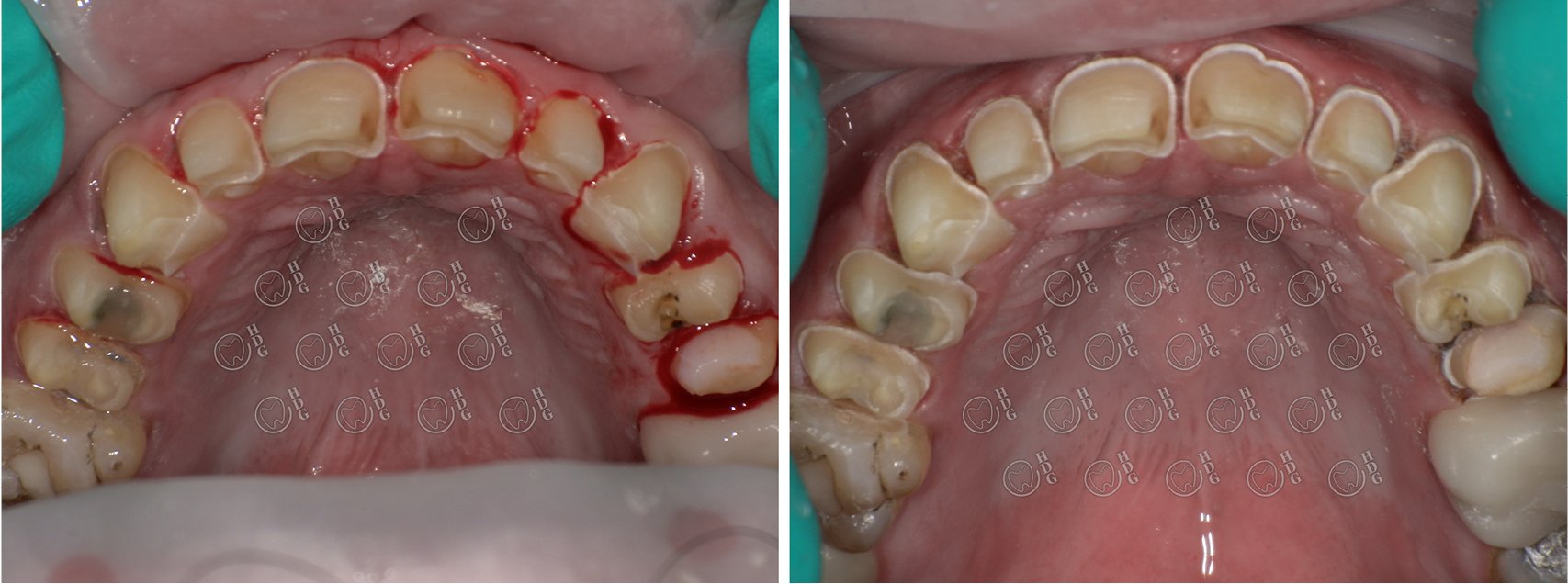
Soft tissue management in cosmetic cases. Hemorrhage is the enemy of bonding. I used to build the whole appointment around the soft tissue, to get the best bonding and to avoid hemorrhage, or at least minimize it wherever possible. Now, with Solea, the soft tissue is the easiest part of the appointment. I can handle it in 30 seconds to a minute, and after 15 to 30 seconds of ViscoStat™ Clear, the field is pristine and clean. I can go right into bonding, and I haven't had a bonding problem since I made this change. For same-day veneers and in-office milled restorations, that stress is just gone.
Deep decay near the pulp. For a young, healthy patient where I'd like to avoid a root canal, a pulp cap traditionally works about half the time. Now I go over the site with the laser because it sterilizes and coagulates, and then I bond over it. Every time I've done this so far, it has been successful.
Removing a severely angled implant. A patient came to me with an implant placed overseas that ran sideways across multiple teeth in the anterior region. The only way to make the case work was to cut the implant out, in an area without a lot of bone to spare. Because of how the 9.3-micron wavelength interacts with its target chromophores, I could aim right at the implant without taking away a lot of bone. I lased the site briefly and placed a bone graft. That evening, I called him to see how he was doing after having the implant removed with the laser. He said he was a bit sore, but mostly fine. Within a few months, everything had healed, and he was very pleased with the outcome. He said he never had any serious post-op discomfort, which is unusual after an implant removal, at least in my experience.
I also use Solea® Sleep™ for my patients who snore. Our practice is very involved in dental sleep medicine, and mandibular advancement devices have been our go-to. For the most part, they work quite well. Since we introduced Solea Sleep, though, several patients have reported a drastic decrease in snoring and in waking up at night after simply lasing the soft tissue of the palate and tonsillar pillars. They're thrilled with the snoring treatment alone.
One patient found me online not long after I got my laser and asked for Solea Sleep because he had done a lot of reading on it. We gave him the snoring treatment along with a mandibular advancement device. Before his device was even delivered to our office, he left us a review after Solea Sleep alone, saying we had saved his life.
People sometimes say a big, complicated case means a big fee. Honestly, dentists don't care about that in the moment. All we're thinking about is the stress. That's why I call Solea my cheat code and my stress reducer.
 |
|
Before and After Maxillary Full-Arch Crown Preps with Solea |
Does Solea really do anesthesia-free fillings?
Yes. In my practice, between 80% and 90% of my fillings are done without anesthesia. Some patients say they feel the cold air and water, along with some sensitivity, and occasionally describe it as slightly uncomfortable. Most say it's nothing worth complaining about, and they would much rather have this than get a shot, get numb, and wait for the numbness to wear off.
We've had several patients come to our office because someone told them we could do fillings without even numbing them. Personally, I'm not looking to do more fillings. But several of those patients needed a significant amount of work and came to us just because they had heard that story. They told us they wanted to go somewhere with the best technology, because they knew they needed a lot done and didn't want to be in pain.
Here's my honest take for prospective buyers: very few dentists want to build their practice around fillings. If you're a "super GP" who does a little of everything, fillings shouldn't be the reason you buy Solea. If you love 30 of the 100+ other things it does, anesthesia-free fillings for most of your patients are a bonus.
Is there a learning curve with the Solea laser?
There is a learning curve, but it's mostly a mindset shift. It just means slowing down and thinking for a minute instead of doing what you'd normally do. Instead of reaching for the scalpel, reach for the laser.
The first day I picked it up and where I am now are not in the same universe, and where I'll be two years from now will be in another one. If you keep trying things and understand the physics behind what you're doing, including when to use the laser and when not to, it keeps getting better.
The Solea community makes that easier. I'll admit that when I first met Solea users, their enthusiasm made me suspicious. I'm a wait-and-see guy. Now I get it. When a few of us get together, it's all "What are you doing for this? Have you tried that?" When I was getting started, Chad connected me with doctors who were pushing the boundaries, and every one of them was happy to help. Chad has been a phenomenal resource. Convergent Dental also offers Solea education and training for doctors at every stage.
Is the Solea laser worth the investment?
For me, absolutely. On paper, Solea is a significant investment, and as a business owner I always have to keep overhead in mind. But once I looked at everything it does and experienced it for myself, the price was easy to justify, and it has paid for itself in spades.
When we compared my production per day for the three months before I got Solea with the three months after, leaving out the month it arrived, it was up 8.5%, even though I worked fewer days. It has changed the way I do almost everything. I work faster, my patients have less post-op discomfort, my outcomes are better, and patients get a real wow factor. It has elevated my clinical dentistry, and it brings in free marketing: patients come to us because they've heard I can do things atraumatically with the laser, when their past experience was a painful recovery.
I've also come to rely on one simple question: what would I want done if I were the patient? That question has been my best practice builder. If I needed treatment and Solea could do it, I would want it done that way, and I would only go to a dentist who has one and who wants to deliver that kind of dentistry with the best tools available.
Part of me doesn't want to tell anybody, because I feel like I've stumbled onto a cheat code. But I believe a rising tide lifts all ships. My advice: get your hands on a Solea laser, push it to its limits, and see what it does for the cases you dread most.
Jackson Hall, DDS, is a third-generation dentist practicing in Middle Tennessee, and he is a veteran of the U.S. Navy. He holds a bachelor's degree in biochemistry from Middle Tennessee State University and a Doctor of Dental Surgery from the University of Tennessee College of Dentistry. After practicing in the Nashville area for several years, he moved to Cookeville, Tennessee, and opened his own practice, Hall Dental Group, where he focuses on all aspects of general dentistry and comprehensive care, including:
- <Cosmetic dentistry
- Full-mouth rehabilitation
- Implants
- Same-day digital dentistry
- Laser dentistry
- Dental sleep medicine
In addition to being a Solea advocate, he is a student of the Kois Center.